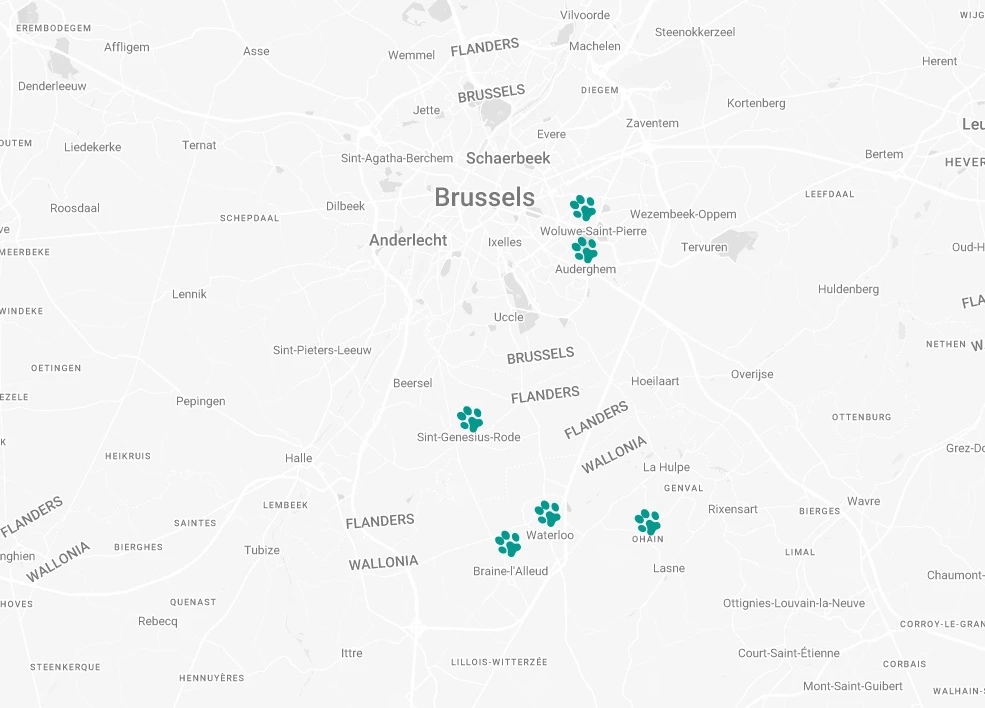
I come to Waterloo itself, but also to Braine-l'Alleud, Rhode-Saint-Genèse, Ohain, Woluwe-Saint-Pierre and Auderghem. If you live further away, an online consultation remains possible, anywhere in Belgium and beyond.
The vast majority of consultations take place at your place, because that is where your dog's behaviors show most naturally. Some situations, such as outdoor reactivity, may call for a session on a walk in your neighborhood.
First contact usually happens within 24 to 48 hours. The first consultation at your place is then scheduled according to our availability.
The first phone contact is free. The behavior assessment at your place and the personalized management and training plan are charged according to a detailed rate card, which I share with you during our first exchanges.
As soon as your dog's behavior worries you or goes beyond what you know how to handle on your own: aggression, intense fear, separation anxiety, or barking and destructive behavior that set in over time. The earlier you act, the faster the progress, but it is never too late to start.
Yes, alongside individual sessions, I offer theme walks in small groups, useful for socialization, positive training and learning to walk on a leash, among others. Online conferences are also scheduled to round out your knowledge of dogs.
They are two complementary professions, and I practice both. The trainer lays solid, positive foundations, even before a problem appears. The behaviorist steps in once a problem has set in, to understand its cause and resolve it for good. Many of my clients in Waterloo call on me for both, at different points in their dog's life.
Ask yourself this: is your dog still learning the basics (recall, leash walking, house training, sit, wait, among others), or does his behavior genuinely worry you (aggression, fear, anxiety)? In the first case, dog training is enough. In the second, behavioral support is called for. If in doubt, simply contact me: I will point you in the right direction from our first exchange.
Yes. I support puppies, adult dogs and rescue dogs, whatever their breed or history. My positive approach adapts to each dog's temperament and pace.
Very much for real: many dogs experience absence as a temporary loss of security, which can show as vocalizing, destructive behavior or agitation at the moment of departure. This is what we call separation anxiety, a common problem I regularly treat during my consultations in Waterloo.
A bored dog may become destructive, bark a lot, become hyperactive or, on the contrary, listless. These signals are not whims: they reflect an unmet need, whether physical, mental or relational.
It is a useful guideline, not an exact science: 3 days to decompress in his new environment, 3 weeks to learn the household routine, 3 months to feel fully confident. Every rescue dog moves at his own pace, and that is precisely what I support, case by case.
A dog does not "sulk" in the human sense, but he can clearly express discomfort or frustration through his behavior: he withdraws, avoids contact or seems distant. Learning to read these signals is part of my work as a behaviorist.