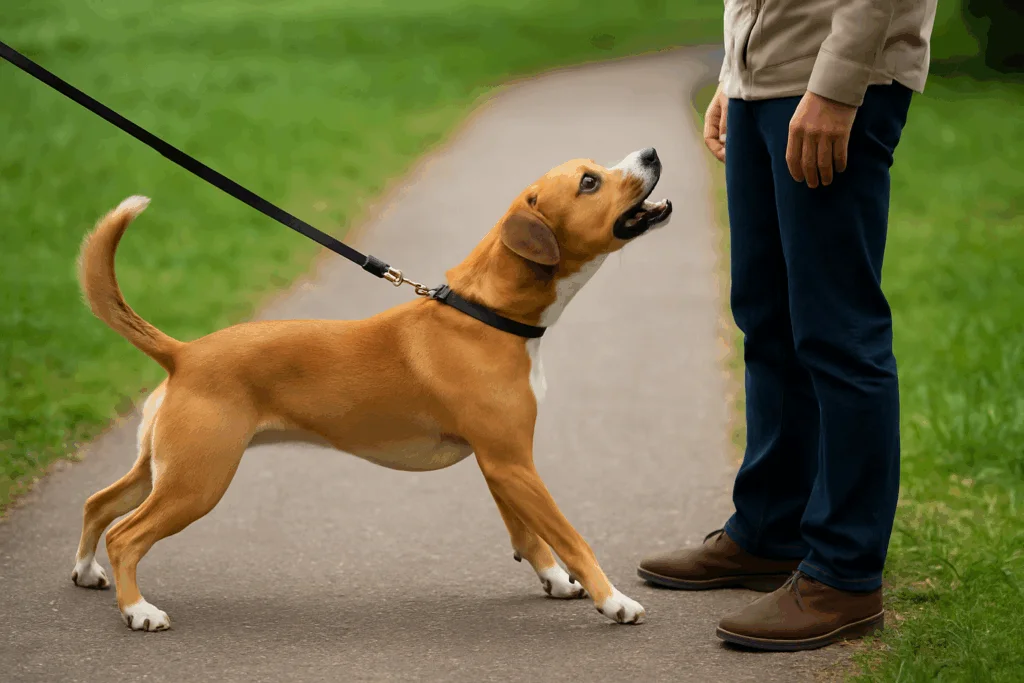
My dog eats grass… is it serious, doctor? It's a question almost every dog guardian asks themselves at some point. You watch your dog sniff a blade of grass at length, savor it like a delicacy or wolf it down in one go… then sometimes vomit, sometimes not. This behavior intrigues, amuses, even worries. So why do dogs eat grass? Is it normal? Are they feeling unwell? Should we stop them?
Spoiler alert: in the vast majority of cases, it is a natural, harmless and even potentially beneficial behavior!
A very common behavior
First of all, you should know that eating grass is extremely common in dogs. According to a study by Hart et al. (2008) of more than 1,500 dog owners, nearly 79% of healthy dogs eat grass at least occasionally. Even more interesting: 91% of them were not unwell before eating grass, and fewer than 25% vomited afterwards.
In other words, vomiting is not the goal. It can happen, but it is not the norm. The idea that dogs eat grass solely "to make themselves vomit" is therefore a persistent myth, but a scientifically unfounded one.
An inherited behavior?
Several scientists believe this habit dates back to the time when dogs lived semi-free, or even to their wild ancestors. Behavioral studies have shown that even wolves occasionally ingest plant matter, often found in the stomachs of their herbivore prey. This behavior could therefore be an evolutionary legacy.
Some researchers also suggest that eating grass could help naturally purge intestinal parasites. Even though modern dogs are dewormed, the behavior may persist as an atavistic behavioral remnant.
An ancestral diet far from 100% meat
We often forget that the ancestors of domestic dogs, although descended from the wolf, did not live by hunting alone. In reality, they long survived on the outskirts of human villages, feeding on waste, food scraps and even… human excrement.
Yes, it's not very glamorous, but it is the historical truth: eating human feces was part of the feeding strategy of these stray dogs, sometimes cast off by humans who abandoned them for not being useful enough (hunting, herding, sledding, guarding, among others).
As a result, dogs' diet has never been strictly meat-based. Their digestive system has adapted over the centuries to a mixed diet, rich in carbohydrates and plants. This may partly explain why eating grass remains a common behavior today, without it indicating a deficiency or an illness.
What if it's simply enjoyable?
Sometimes the simplest answer is the right one. It is possible that dogs eat grass simply because they enjoy it. Some grasses are tender, fresh, with a slightly sweet or bitter taste. Young shoots, in particular, seem especially popular.
What's more, grass stimulates the sense of smell, and exploring a tuft of lawn can be part of an enjoyable sensory ritual: sniffing, chewing, exploring. In short, eating grass satisfies a good number of needs!
Emotional regulation?
Some dogs eat grass more frantically, especially in situations of stress or frustration. It can then be part of a self-soothing behavior: chewing something long and fibrous can calm a tense dog, just as we humans chew on a pencil or nibble a piece of bread to relax.
If you notice this behavior in your dog in specific contexts (after a frustration, before a walk, in your absence), it may be an emotional indicator rather than a digestive problem. In that case, make sure he has safe bones or chew objects to release the tension.
Is it dangerous?
In the vast majority of cases: no. Grass itself is not toxic, and moderate ingestion is not a problem.
A few precautions are nevertheless in order:
- Beware of chemical treatments (pesticides, weedkillers) on public or private lawns.
- Some garden plants are toxic to dogs: lily of the valley, oleander, lilies, ficus, etc.
- If your dog eats large quantities of grass every day, systematically vomits, has diarrhea or shows obsessive behavior, it is important to talk to your veterinarian.
A symptom of another problem?
Although this behavior is most often benign, it can sometimes reveal digestive discomfort, a need to induce vomiting (very rare), or a behavior linked to anxiety.
A dog who rushes at grass, vomits afterwards, seems listless or shows other signs of discomfort (excessive licking, loss of appetite, diarrhea, etc.) deserves a full veterinary assessment.
Should you stop him?
The short answer is: no, unless it is excessive or dangerous. A dog who eats a little grass from time to time, on an untreated lawn, is expressing a natural behavior — perhaps enjoyable, perhaps inherited, perhaps emotional — but rarely problematic.
You can even offer him some "home-grown grass", such as a small tray of young barley or wheat shoots, grown in a pot on your balcony or in your garden.
What science says
Here are a few scientific studies that support these observations:
- Hart et al. (2008): 79% of dogs eat grass, 91% were not unwell beforehand, and fewer than 25% vomited afterwards.
- Sueda, Hart & Cliff (2008): behavior more frequent in young dogs, with no clear link to illness.
- Bjone et al. (2007): confirms the absence of any systematic correlation between eating grass and digestive discomfort.
In summary: this behavior is normal, common and non-pathological.
So what about those "super kibbles" that promise to restore gut flora?
The sales pitch of kibble or supplement vendors, which boils down to saying that if your dog eats grass, licks his paws, etc., his gut health must be poor and their kibble will fix everything, is a bluff — pure marketing. They create a false problem to attract naive buyers. We have seen what to think and what to do when your dog eats grass. And you go to the vet before buying "miracle" kibble; that goes for everything!
Conclusion: nothing alarming… with a few exceptions
Your dog eats grass? Don't panic. As long as he doesn't do it obsessively, doesn't swallow toxic plants, and stays healthy, let him be.
It is a natural behavior, sometimes inherited, sometimes sensory, sometimes emotional… but rarely worrying. As always, careful observation of the context and of the rest of his behavior is the best compass.
Sonia Quertenmont, your Dog Nanny