A behaviorist analyzes the origin of your dog's behavior problems (fear, aggression, anxiety, barking) to offer suitable support. Unlike standard training, a behaviorist works on the root causes of a problem that has already set in, in order to restore a peaceful relationship between you and your dog.
As soon as you notice unusual signals in your dog: anxiety, aggression, excessive barking, fear or repeated destructive behavior. The earlier the intervention, the faster and more lasting the results. If in doubt, don't hesitate to contact me to talk it through.
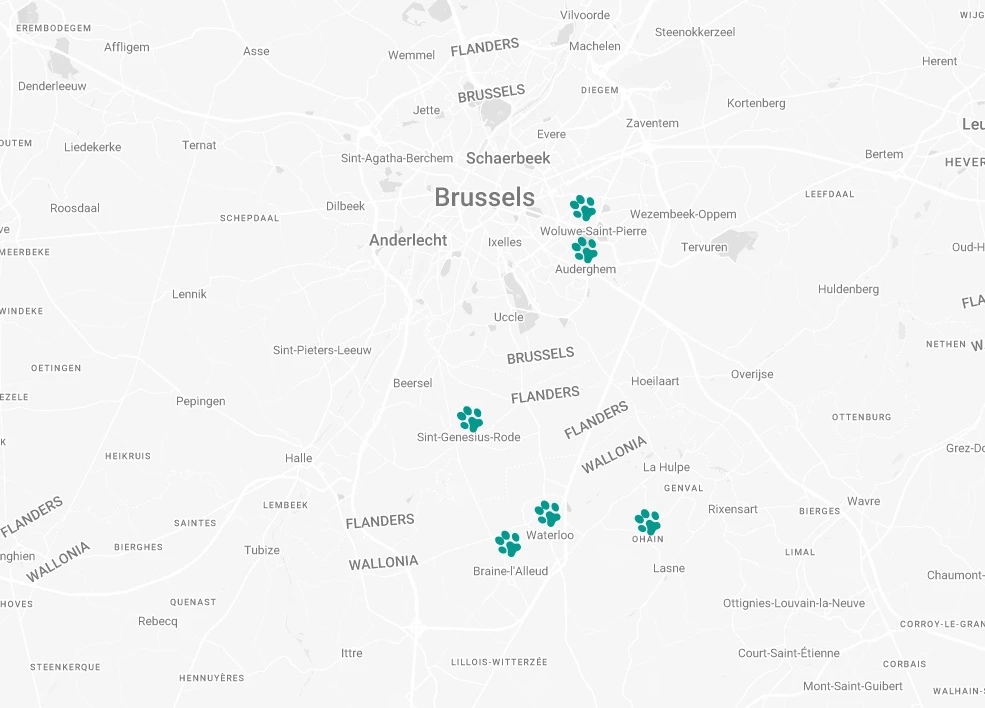
I come to Rhode-Saint-Genèse, but also to Waterloo, Braine-l'Alleud, Ohain, Woluwe-Saint-Pierre and Auderghem. If you live further away, an online consultation remains possible, anywhere in Belgium and beyond.
The vast majority of consultations take place at your place, because that is where your dog's behaviors show most naturally. Some situations, such as outdoor reactivity, may call for a session on a walk, particularly around the Sonian Forest.
First contact usually happens within 24 to 48 hours. The first consultation at your place is then scheduled according to our availability and the urgency of the situation.
The first phone contact is free. The behavior assessment at your place and the personalized management and training plan are charged according to a detailed rate card, which I share with you during our first exchanges.
It is not compulsory, but it is sometimes useful: some behavior problems have a medical origin. I am happy to work with your veterinarian to rule out that possibility before starting behavioral support.
I support dogs showing anxiety, reactivity, aggression, excessive barking, destructive behavior, predatory instinct or trauma. Every support plan is adapted to the animal's history and temperament.
This rule describes the main stages of a rescue dog's adjustment to his new home: 3 days to decompress, 3 weeks to learn his routine, and 3 months to feel fully at home. I use it as a guideline in my work, without ever applying it rigidly: every dog moves at his own pace.
Punishment often reinforces fear rather than understanding. I favor a positive approach: redirecting the dog towards an appropriate behavior, then rewarding him, is far more effective for anchoring lasting learning. That is the heart of my method in Rhode-Saint-Genèse.
I practice both professions, which naturally complement each other. Dog training comes first, to lay good foundations before a problem sets in. Behaviorist work begins once a difficulty is clearly present, to identify its cause and respond to it for good.
Ask yourself this: is your dog still learning the basics (sit, down, recall, leash walking, house training, stay, wait, leave it, drop it), or does his behavior genuinely worry you (aggression, fear, anxiety)? In the first case, dog training is enough. In the second, behavioral support is called for. If in doubt, simply contact me: I will point you in the right direction from our first exchange.
A 15-minute call is offered within two weeks of the consultation. If one or more further consultations are needed, I tell you so transparently.
Yes, my client reviews are available online on Google. They reflect my field experience and the quality of my services, whatever the activity or reactivity level of the dog I supported.