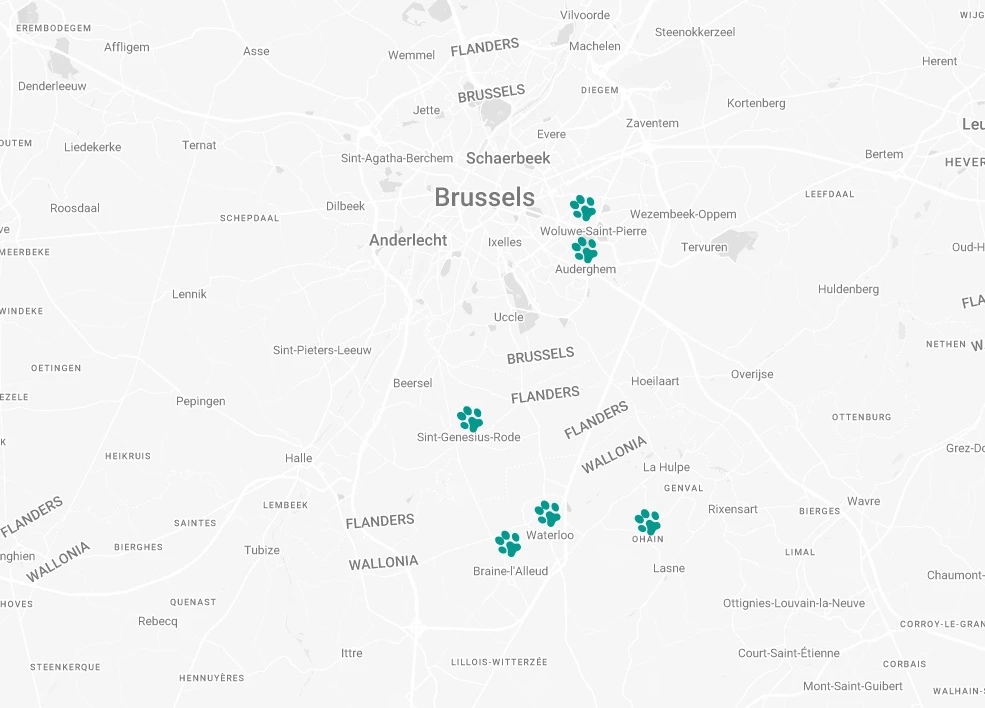
I come to Ohain itself, to nearby municipalities such as Waterloo, and to other municipalities in Walloon Brabant and the Brussels region. Beyond that, an online consultation remains possible, anywhere in Belgium and beyond.
The vast majority of consultations take place at your place, because that is where your dog's behavior shows most naturally. Some situations, such as outdoor reactivity, may call for a session on a walk in your neighborhood or in a large park.
First contact usually happens within 24 to 48 hours. The first appointment at your place is then scheduled according to our availability, often within the following days.
The first phone call is free. The behavior assessment at your place and the personalized management and training plan are charged according to a rate card, shared from our very first exchanges: it depends on the nature of the problem and the number of sessions needed.
It is not an essential step, but it can be useful: some behaviors stem from a health problem rather than from the training received. I am happy to work with animal health professionals, such as your dog's veterinarian, to rule out that possibility before starting support.
Yes, alongside individual sessions, I offer theme walks in small groups, useful for socialization and canine activities.
They are two complementary professions that I practice. The trainer lays the positive foundations so that your dog feels safe and learns the basics, before a problem appears. The behaviorist steps in once a problem has set in, to understand its cause and resolve it for good.
If your dog is still learning the basics (sit, down, stay, wait, recall, leash walking, house training), dog training is generally enough. If his behavior genuinely worries you (aggression, fear, anxiety), behavioral support is more appropriate. If in doubt, contact me: I will guide you from our first exchange.
Faced with a stressful situation, a dog reacts according to four main strategies: fight, flight, freeze or fidget. Identifying which one dominates in your dog is a key step in my work as a behaviorist, because it directly shapes the support plan.
This rule gives a guideline for a newly adopted dog's adjustment, especially a rescue dog: roughly 3 days to decompress and observe, 3 weeks to learn the routines of his new home, and 3 months to feel fully at home. It is a useful guideline, but not an exact science. Every dog progresses at his own pace: that is precisely what I assess during support.
They generally include recall, “sit”, “down”, “stand”, “stay”, “wait”, “leave it” or “drop it”, and loose-leash walking. These are useful foundations, but learning them must remain positive and suited to your dog's temperament rather than rigidly imposed.