Dog behaviorist: anxiety in dogs

Does your dog tremble, bark, bite, chew or relieve himself indoors as soon as you leave? These behaviors are not whims. Anxiety in dogs is a real condition that causes genuine distress for the animal. I come to your home in Walloon Brabant and Brussels to identify the triggers and build an appropriate protocol with you.

Visible behavioral signs

Destruction when you leave, continuous barking or whining, house soiling in an otherwise house-trained dog, escape attempts or hiding in a corner where he can't be reached: these behaviors express a distress your dog cannot manage any other way.

Calming signals

Repeated yawning when not tired, nose licking, looking or turning the head away, scratching: these are examples of calming signals. Your dog is trying to lower his own tension or to signal that he is not a threat or does not wish to interact. These behaviors are often overlooked by owners, even though they indicate discomfort.

Physical signs of stress

Excessive panting without exertion, trembling, drooling, low tail, ears pinned back, dilated pupils: these are automatic responses of the nervous system that reveal anxiety. Unlike calming signals, the dog has no control over them.

Signs in general health

Chronic anxiety can also show in the animal's general health: recurring digestive issues, loss of appetite, withdrawal, refusing to eat or drink, heightened reactivity to everyday stimuli, resistance to being touched, among others. These signs indicate that stress has set in over time. I always recommend a veterinary consultation first, to rule out any organic cause.
Does one of these situations sound familiar?
First contact is free, with no commitment.
Contact me

How does the support work?

Every case starts at your home or outdoors, depending on whether your dog feels unwell at home or is socially phobic; in short, wherever the problems actually occur. I observe your dog in his environment, listen to what you have been through, and identify the triggers. On that basis, I build a protocol suited to your dog and your daily life.
01

First contact
Free

We talk by phone or in writing: you describe your dog's situation, his living environment and what you expect. No commitment.
02

Dog behavior assessment
€95

I come to your home. I observe your dog in his environment, gather his history and analyze what is going on. Concrete advice you can apply that very evening.
03

Personalized management and training plan
€65
(optional but very useful!)

A tailor-made protocol, adapted to your dog's profile and your pace of life. I work only with positive methods — treats, play, attention, petting or any other reinforcer that suits your dog — always without punishment or coercion. Every exercise is explained and justified.
04

Follow-up
complimentary

A 15-minute call is offered within two weeks of the consultation.

What causes anxiety in dogs?

The causes of anxiety in dogs are many and often intertwined. Understanding the origin of the problem is essential before any support begins. Here are the situations I most often encounter with the dogs I work with.
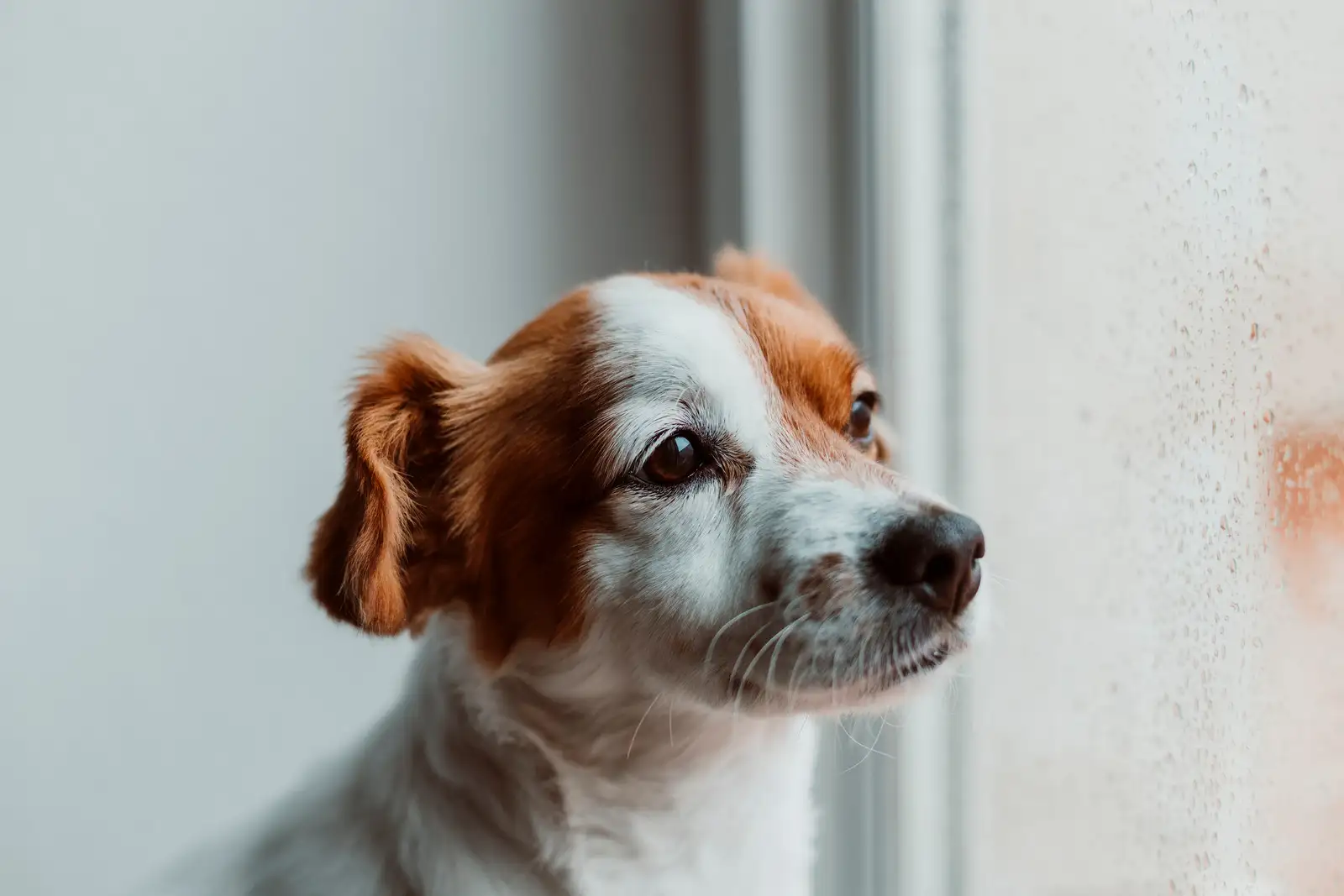
Portrait d'un chien blanc et roux regardant par la fenêtre

Separation and the attachment bond

Separation anxiety mainly affects dogs who have never been used to being alone, whether from a very young age or as adults. It can also stem from hyper-attachment.
This affects dogs whose attachment bond with their owner is extremely intense. The dog follows his owner everywhere, panics as soon as he loses eye contact, and cannot be left alone without showing distress. As soon as the owner leaves the house, destruction, barking and house soiling follow one after another.
Chien assis devant une fenêtre pendant un feu d'artifice

Phobias and fear of outside stimuli

Some dogs develop an intense, disproportionate fear of specific situations: thunderstorms, fireworks, sudden noises. These phobias can appear for no obvious reason, or follow a traumatic experience or a lack of socialization, which we cover below. A dog who is repeatedly stressed develops growing sensitivity to triggers.
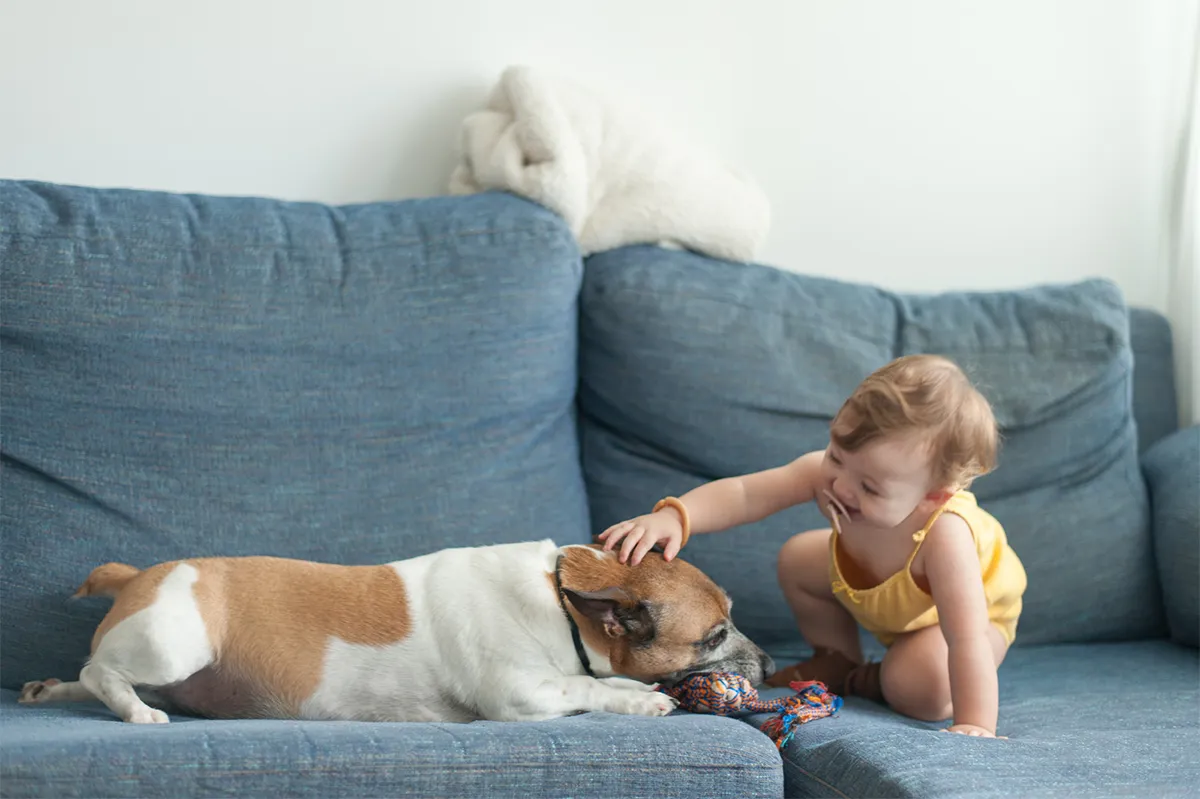
Enfant jouant avec un chien sur un canapé

Changes in routine

Moving house, the arrival of a baby, the loss of a canine companion: these changes in routine can deeply unsettle a dog. Animals need stability to feel safe. When their landmarks disappear, anxiety can set in quickly.
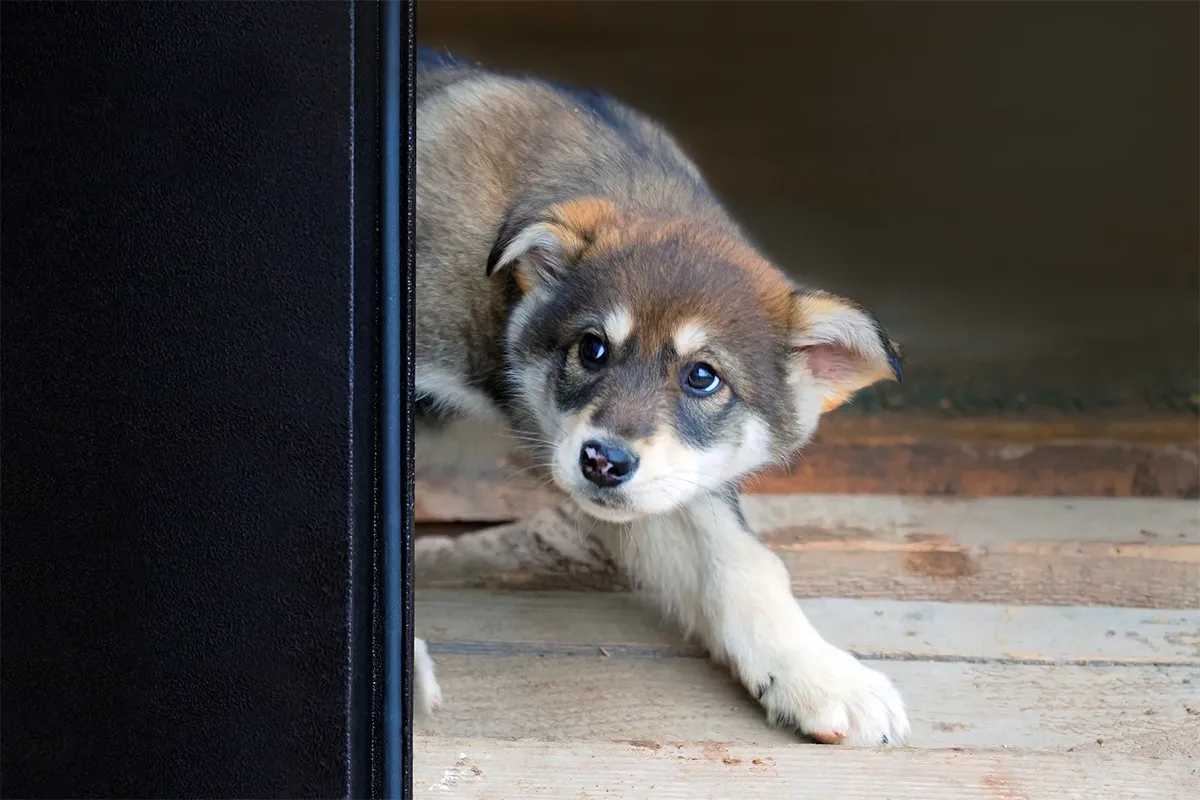
Chiot curieux près d'une porte

Insufficient puppy socialization

A puppy who is insufficiently socialized between 3 and 14 weeks — first at the breeder's, then at your place — is more likely to develop anxiety problems as an adult. Gradual, positive exposure to people, other dogs, sounds, smells and varied environments is an essential foundation for his future emotional balance.

FAQ: anxiety in dogs

Temporary stress is a normal reaction to a one-off situation. Anxiety, on the other hand, sets in over time and affects the animal's daily life even in the absence of any identifiable trigger. If the symptoms persist beyond two weeks or intensify, it is time to consult.

In the vast majority of cases, yes. Canine anxiety responds well to an appropriate behavior protocol, particularly once the causes are identified and addressed. Results depend on the type of problem, the dog's genetics, rejection by the mother caused by the stress of producing litter after litter (often the case for puppies from “puppy mills” and multi-breed “breeders”), illness, his training, the trust he has in his owner, and the time his owner gives him.

Not systematically. Some severe cases benefit from temporary medical support, prescribed by a veterinary behaviorist. It is never an end in itself: medication supports dog behaviorism, it does not replace it. It calms the symptoms, not the cause.

To quote Dr. Lisa Radosta, an American veterinarian respected worldwide: “I will never prescribe medication to resolve your dog's stress without in-depth dog behaviorism.” Dr. Kathy Murphy advocates the same. Let's work together for ethics and animal welfare.

Some breeds are indeed more predisposed to hyper-attachment and separation anxiety. But any dog, whatever his breed, can develop an anxiety problem depending on his history, his environment and the events he has been through.

Yes, to a large extent. Good puppy socialization between 3 and 14 weeks, a stable routine, meeting his needs for safety as well as his cognitive and scent-work needs, gradually introduced periods alone, and positive training are the best foundations for preventing anxiety problems in adulthood.

It depends on the severity of the problem, how long it has been going on, and the owners' involvement. Some dogs show significant progress within the first few weeks. Others require follow-up over several months. I give you a realistic estimate during the behavior assessment, with no commitment.

When should you consult?

Consult without delay as soon as your dog joins your household, to prevent separation anxiety or distress. Separation anxiety, for example, is one of the most difficult problems to manage and one of the most time-consuming — unless things are done in the right order! If your dog has shown signs of anxiety for more than two to three weeks, if his condition is getting worse despite your efforts, or if the behaviors triggered by his stress are becoming dangerous, consult.

The longer a canine problem sets in, the more time it takes to resolve. A prior veterinary check-up is always recommended to rule out a medical cause or underlying pain.
Your dog is sending you signals. 
Let's learn to understand them together.
arrow-upplus-circle